
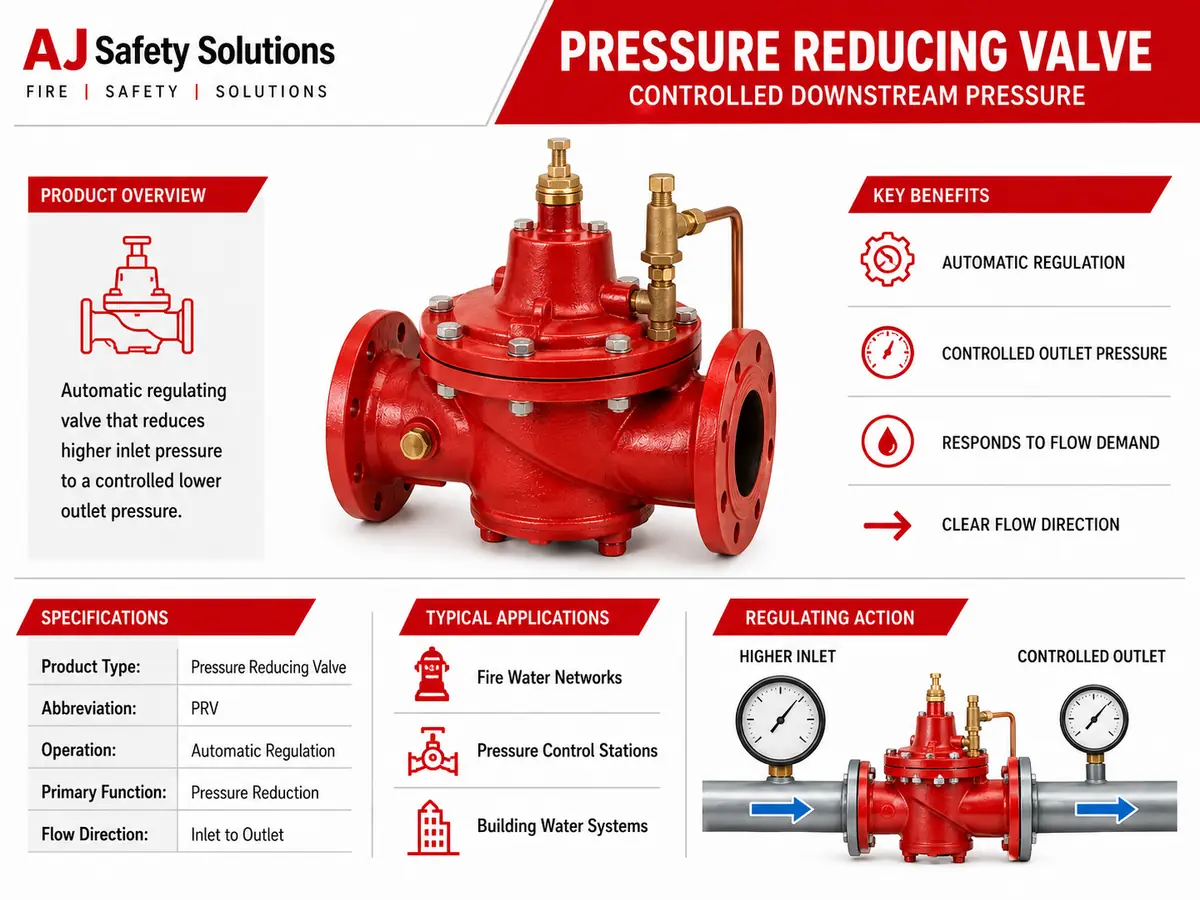
Pressure Reducing Valve (PRV) for Fire-Water Networks
A pressure reducing valve is an automatic regulator that lowers a higher inlet pressure to a controlled downstream pressure. In a properly engineered water-based system, this function can help establish the required pressure condition for downstream piping, valves, or outlets.
Coordinate your project through AJ Safety Solutions, view related products in the fire valve range, and review the associated water supply equipment that feeds the fire-water network.
Automatic Regulating Action
A PRV responds to downstream pressure through its regulating mechanism. As system demand changes, the valve modulates the flow path to maintain the intended outlet condition within the capability of the selected model and installed arrangement. This differs from a simple isolation valve, which is normally used only in fully open or fully closed positions.
Key Functional Features
- Automatically reduces higher inlet pressure toward a controlled downstream level.
- Responds to changing flow demand through a regulating action.
- Provides a defined inlet-to-outlet flow direction.
- Can form part of an engineered pressure-control station.
Typical Applications
Pressure reducing valves may be used in building fire-water networks, pressure zones, riser arrangements, pump-fed systems, and other locations where the approved hydraulic design requires pressure control. Installation details may include upstream and downstream isolation, gauges, strainers, bypasses, or test points when specified by the designer.
Project Specification Notes
Valve size, body pattern, pilot arrangement, adjustment range, maximum inlet pressure, downstream set point, connection type, material, and approvals are model-specific. No numerical value is assumed here. Selection and commissioning should follow the approved hydraulic calculations and the manufacturer’s technical data.
Standards and Maintenance References
Review NFPA 14 for standpipe and hose system requirements and NFPA 25 for inspection, testing, and maintenance guidance. The adopted code, authority having jurisdiction, and approved design remain controlling.





Reviews
There are no reviews yet.