
Reducers for Fire Pipe Networks
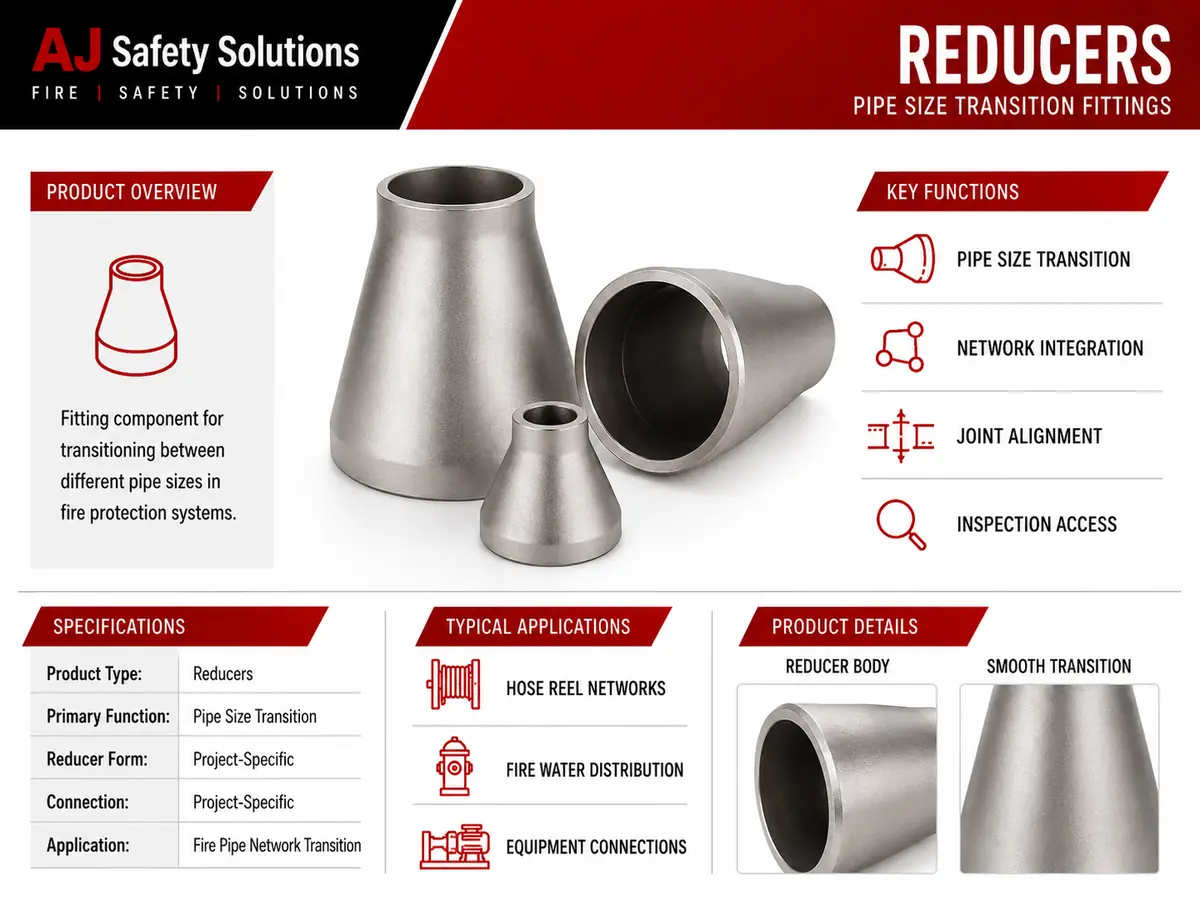
Reducers are transition fittings used where an engineered fire pipe network changes from one pipe size to another. They connect two documented route sections while keeping the transition identifiable within the overall fire water distribution arrangement.
The term Reducers covers more than one geometry and connection style. It does not by itself identify concentric or eccentric form, inlet and outlet sizes, material, end preparation, pressure capability or standard. Those details have to match the drawings, hydraulic design and component schedule for the exact transition location.
Key Features and System Role
- Provides a defined interface between two project-specified pipe sizes.
- Supports coordinated transition toward branches, valves or equipment connections shown in the design.
- Allows reducer geometry and joining method to be chosen for the actual route and adjoining components.
- Keeps the transition point visible for examination of alignment, joints and surrounding support.
Typical Applications
Reducers may appear near branch changes, equipment interfaces, valve arrangements or other locations where the approved fire water network changes pipe size. The fitting must correspond to the direction and geometry shown on the drawings. Installation access and the relationship to nearby supports should be reviewed before work begins.
Specification and Project Coordination
Confirm both connected pipe sizes, reducer form, orientation, material or grade, end connections, finish and joining method. Check whether the design requires specific alignment or support conditions. Do not infer dimensions, pressure class, fitting standard or approval status from the generic product name or from an image.
Installation, Inspection and Maintenance
Inspect the reducer and joint surfaces before installation, then align both pipe sections without unintended offset or strain. Verify orientation against the drawing, complete the specified joints and test the assembled section. Future checks should include leakage, damage, unusual movement, disturbed supports and continued access to the transition.
Explore Fire Pipe Network Solutions
For supply support and project coordination, contact AJ Safety Solutions. Review the complete Fire Pipe Network product range and coordinate this item with related fire valves where required by the approved system design.
Reference Standards
Project teams may consult NFPA 14 for the applicable standpipe and hose system framework and NFPA 25 for inspection, testing and maintenance context. The project specification and authority having jurisdiction determine the applicable requirements.




Reviews
There are no reviews yet.