
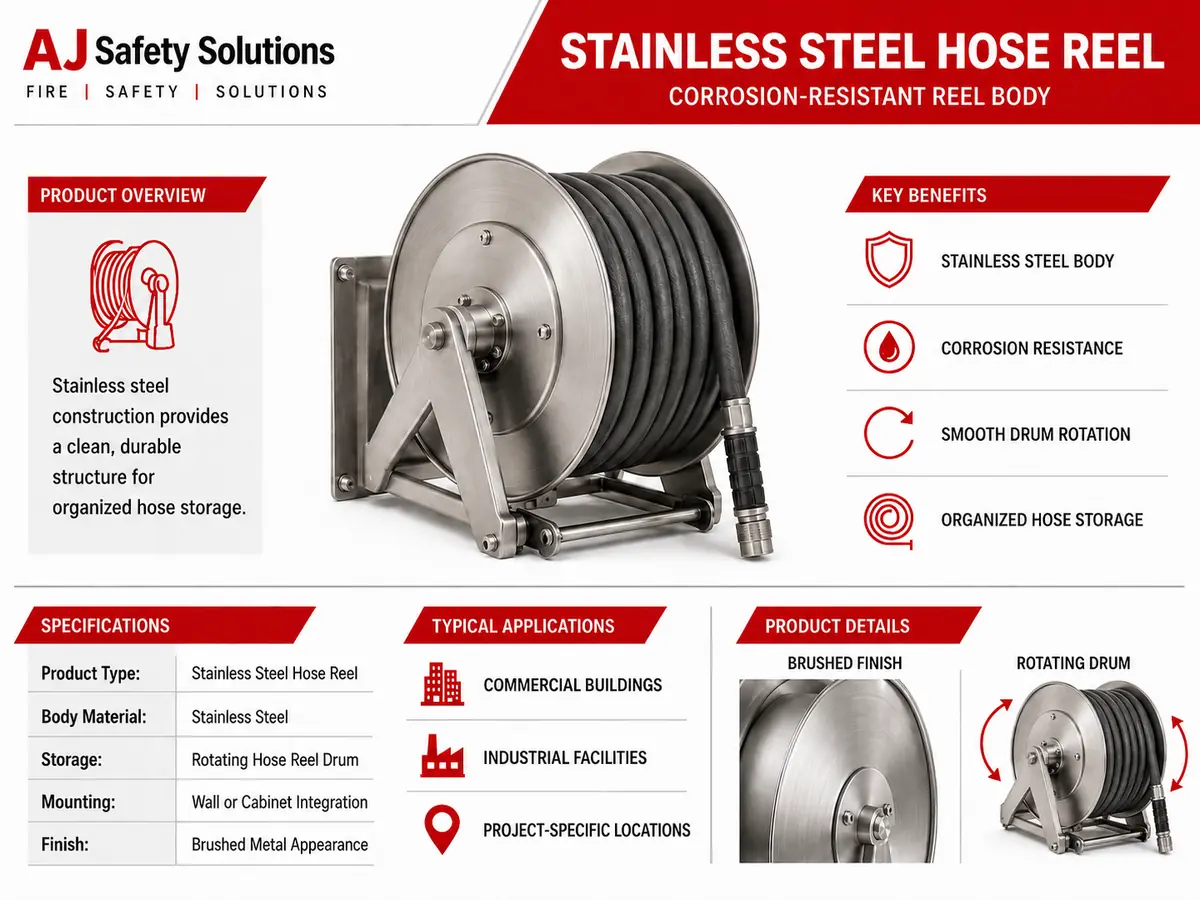
Stainless Steel Hose Reel with Corrosion-Resistant Construction
A stainless steel hose reel uses a metallic drum and supporting structure to keep firefighting hose organized at a designated fire point. Stainless steel construction offers corrosion resistance and a clean finished appearance, while the rotating reel arrangement supports controlled hose withdrawal.
Request project coordination from AJ Safety Solutions, browse the related hose reel equipment range, and arrange appropriate hose reel testing and maintenance after installation.
Metallic Reel Structure
The drum flanges, central hub, support frame, and mounting interface form the principal reel structure. A brushed metal appearance can suit environments where cleanability, finish consistency, or corrosion resistance is important. Actual suitability still depends on the stainless grade, fabrication, fittings, environment, and maintenance program confirmed for the project.
Key Functional Features
- Stainless steel reel body provides a corrosion-resistant structural surface.
- Rotating drum keeps the firefighting hose arranged in a compact coil.
- Open mechanical layout allows access to the hub, supports, and hose path.
- Wall or cabinet integration supports a visible and organized fire point.
Typical Applications
Stainless steel hose reels may be considered for commercial, industrial, utility, food-service, healthcare, or moisture-prone project areas when the approved specification calls for stainless construction. Indoor or outdoor suitability must not be assumed from material appearance alone; the complete assembly and installation environment require technical review.
Project Specification Notes
Stainless grade, surface finish, hose length, diameter, pressure, flow, reel dimensions, inlet configuration, nozzle, bracket, certification, and included accessories are model-specific. This description makes no claim for an unverified grade, rating, approval, or environmental classification.
Standards and Maintenance References
Consult NFPA 14 for applicable standpipe and hose system requirements and NFPA 25 for inspection, testing, and maintenance guidance. The locally adopted code, approved design, manufacturer data, and authority having jurisdiction determine acceptance.


Reviews
There are no reviews yet.