Tee Fittings for Fire Pipe Networks
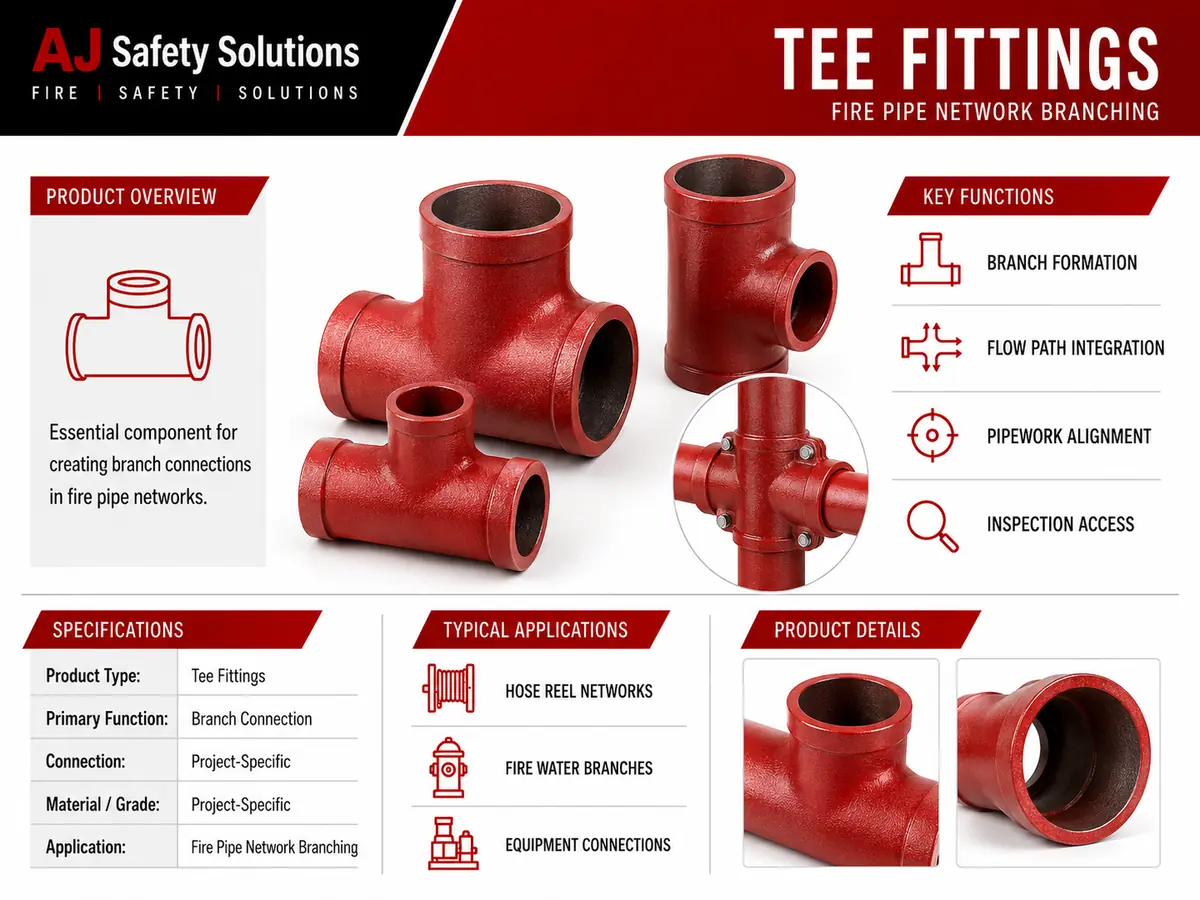
Tee Fittings establish a branch connection within a fire pipe network, allowing one planned pipe route to serve an additional line or equipment path. They are important coordination points because the main run, branch and joining arrangement must all match the approved distribution layout.
A generic tee description does not determine whether the fitting is equal or reducing, nor does it establish size, material, end preparation, pressure capability or joining standard. The branch configuration must be taken directly from drawings and schedules. This prevents an apparently similar fitting from being used where its geometry or connection method is unsuitable.
Key Features and System Role
- Creates a defined branch point in configured fire water distribution pipework.
- Connects a main run with a planned secondary route leading toward equipment or another network section.
- Allows the connection system and material family to be matched to the adjoining pipes.
- Provides a visible network junction that can be checked during installation and routine inspection.
Typical Applications
Tee Fittings may be used at hose reel branches, equipment take-offs, distribution junctions and other designed branch locations. The exact arrangement depends on pipe sizing, route direction and the network design. Access around the junction should be considered where joints, supports or nearby components require future inspection.
Specification and Project Coordination
Confirm the main-run size, branch size, equal or reducing configuration, material or grade, end connections, finish and joining process from approved documents. Review the support and restraint arrangement around the junction. No dimensions, ratings, standards or certifications should be assumed from the general Tee Fittings name.
Installation, Inspection and Maintenance
Before assembly, inspect all openings, joint surfaces and the fitting body for contamination or damage. Align the three connected routes without forcing the joint. After installation, examine connection completion and nearby supports, carry out the project-specified testing, and include the branch point in routine checks for leakage, damage, movement and clear access.
Explore Fire Pipe Network Solutions
For supply support and project coordination, contact AJ Safety Solutions. Review the complete Fire Pipe Network product range and coordinate this item with related fire valves where required by the approved system design.
Reference Standards
Project teams may consult NFPA 14 for the applicable standpipe and hose system framework and NFPA 25 for inspection, testing and maintenance context. The project specification and authority having jurisdiction determine the applicable requirements.
Reviews
There are no reviews yet.