Semi-Rigid Fire Hose for Compatible Hose Reel Assemblies
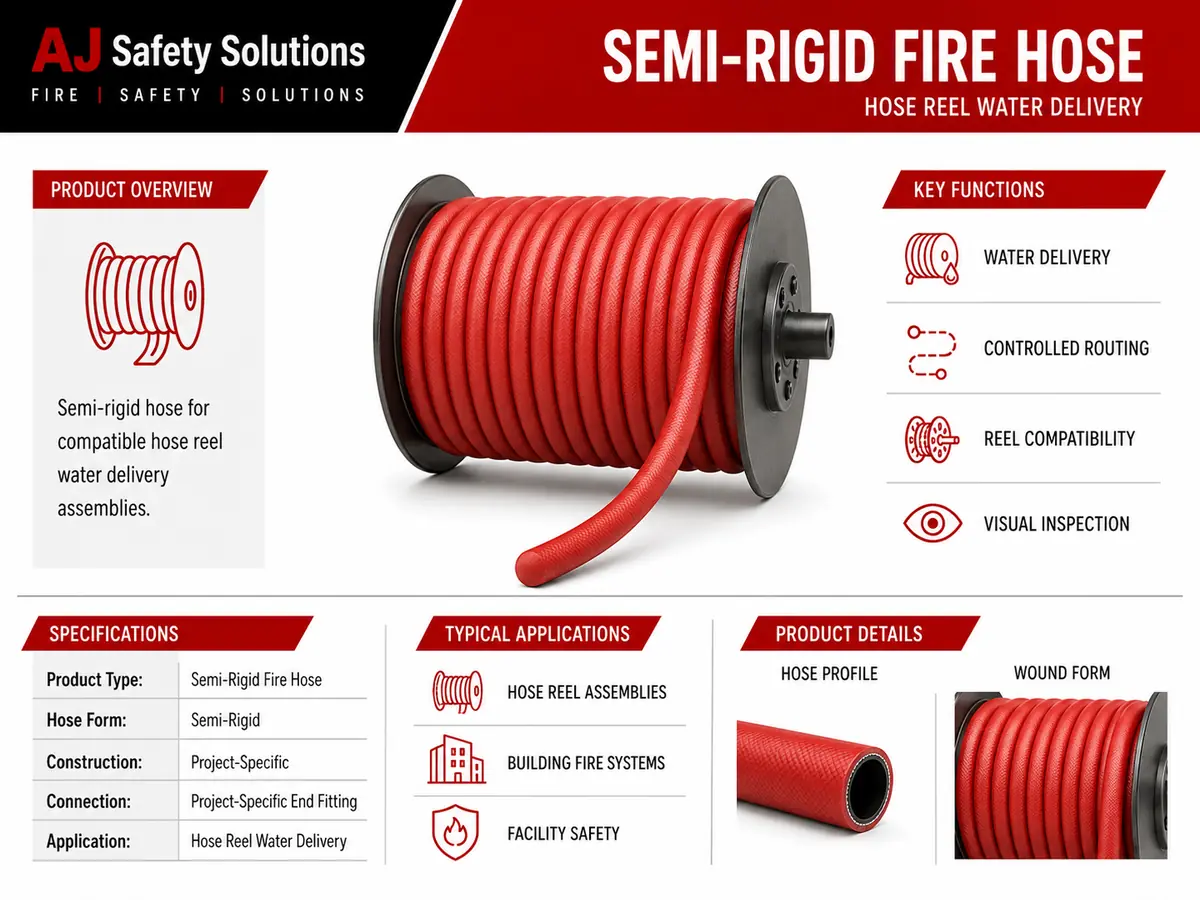
Semi-Rigid Fire Hose is formed to retain a defined hose profile while winding on and deploying from a compatible reel arrangement. It provides the water passage between the reel inlet assembly and the specified outlet fitting. The semi-rigid form identifies the product type, but it does not establish dimensions, layer construction, pressure performance or compliance with a particular standard.
Plan the complete assembly with AJ Safety Solutions, compare the available fire hose products, and coordinate winding and routing with suitable hose reel equipment.
Reel Storage and Deployment
The hose should sit evenly on the compatible drum and travel through the specified guide path without twisting, flattening or rubbing against sharp cabinet edges. Its formed profile can support reel storage, but drum capacity, winding behaviour and deployment route must be checked using the actual hose dimensions and approved equipment drawing.
Functional Considerations
- Semi-rigid form retains a recognisable hose profile during compatible reel use.
- Continuous hose body carries water between approved assembly components.
- Project-specific end connection allows coordination with the selected fittings.
- Visible winding and hose surfaces support inspection and maintenance access.
Typical Applications
Semi-rigid fire hose may be used in fixed hose reel installations, fire hose cabinets, commercial buildings, industrial facilities and other approved building fire systems. Selection should consider reel geometry, intended deployment route, operating conditions, environmental exposure and the complete fire strategy for the location.
Specification and Ordering Notes
Confirm nominal bore, outside diameter, length, wall layers, reinforcement, cover and lining materials, working and test pressure, bend radius, temperature limits, connection, coupling compatibility, colour, marking, approval and supplied accessories. No numeric performance, specific material grade, certification or included fitting is assumed in this generic record.
Inspection and Standards Context
Planned inspection should cover winding condition, hose surface, end areas, guide contact points, leakage and full deployment route according to the system programme. Teams may consult NFPA 14 for relevant standpipe and hose system requirements and NFPA 25 for inspection, testing and maintenance guidance. Approved design documents, locally adopted requirements, manufacturer instructions and the authority having jurisdiction remain controlling.





Reviews
There are no reviews yet.