
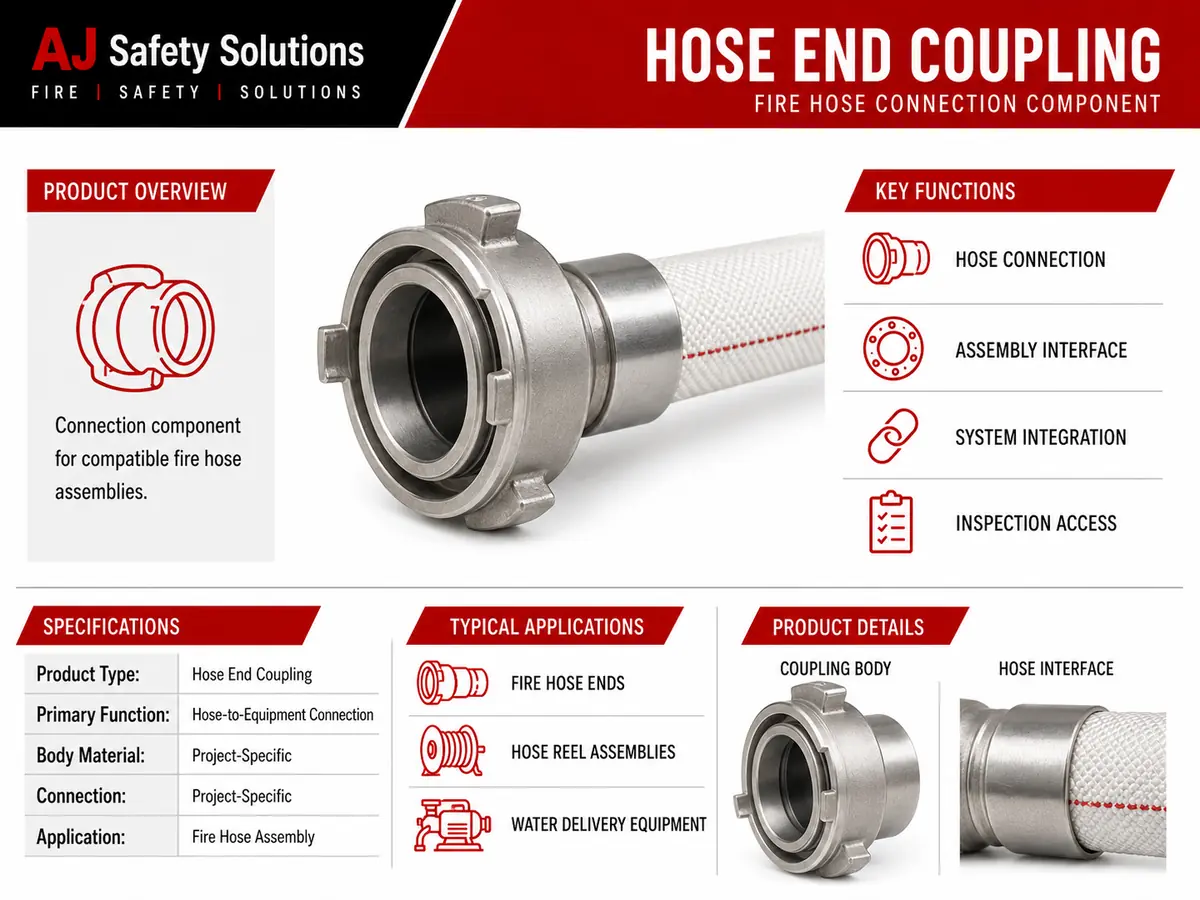
Hose End Coupling for Fire Hose Assembly Connections
A Hose End Coupling provides the mechanical interface between a compatible fire hose end and the connected reel, nozzle, valve or other approved equipment. The coupling body, hose-retention method and mating connection must work together as one verified assembly. A generic product name cannot establish the required thread, lug pattern, size, material or pressure capability.
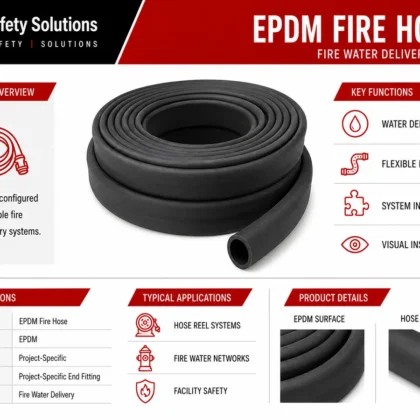
Discuss the connection requirement with AJ Safety Solutions, review the associated fire hose products, and coordinate related parts through the hose reel accessories category.
Hose-to-Equipment Interface
One side of the coupling is secured to the prepared hose end, while the other side mates with the specified equipment connection. Correct alignment and retention help maintain the intended water path. The actual assembly method may use project-specific components and tools; it should follow the hose and coupling manufacturer’s documented procedure.
Functional Considerations
- Creates a defined interface between the fire hose and compatible equipment.
- Supports assembly alignment at the hose end connection point.
- Accessible body surfaces allow identification and routine visual inspection.
- Project-specific configuration permits matching with the approved system design.
Typical Applications
Hose end couplings may be coordinated at hose reel outlets, nozzle connections, replacement hose assemblies, cabinet hose systems and other fire water delivery points. Each mating part should be checked for dimensional compatibility, connection engagement and suitability for the selected hose construction before installation.
Specification and Ordering Notes
Confirm connection type, nominal size, hose-tail geometry, body material and grade, sealing arrangement, retention method, finish, pressure rating, rotation feature, gasket, approval, marking and included components. No thread standard, coupling size, alloy, certification, universal compatibility or supplied clamp is asserted in this record.
Inspection and Standards Context
Inspect the coupling for looseness, damage, leakage, corrosion, seal condition and secure attachment to the hose. Refer to NFPA 14 for relevant standpipe and hose system requirements and NFPA 25 for inspection, testing and maintenance guidance. The approved design, adopted codes, manufacturer instructions and authority having jurisdiction determine final connection requirements.





Reviews
There are no reviews yet.