
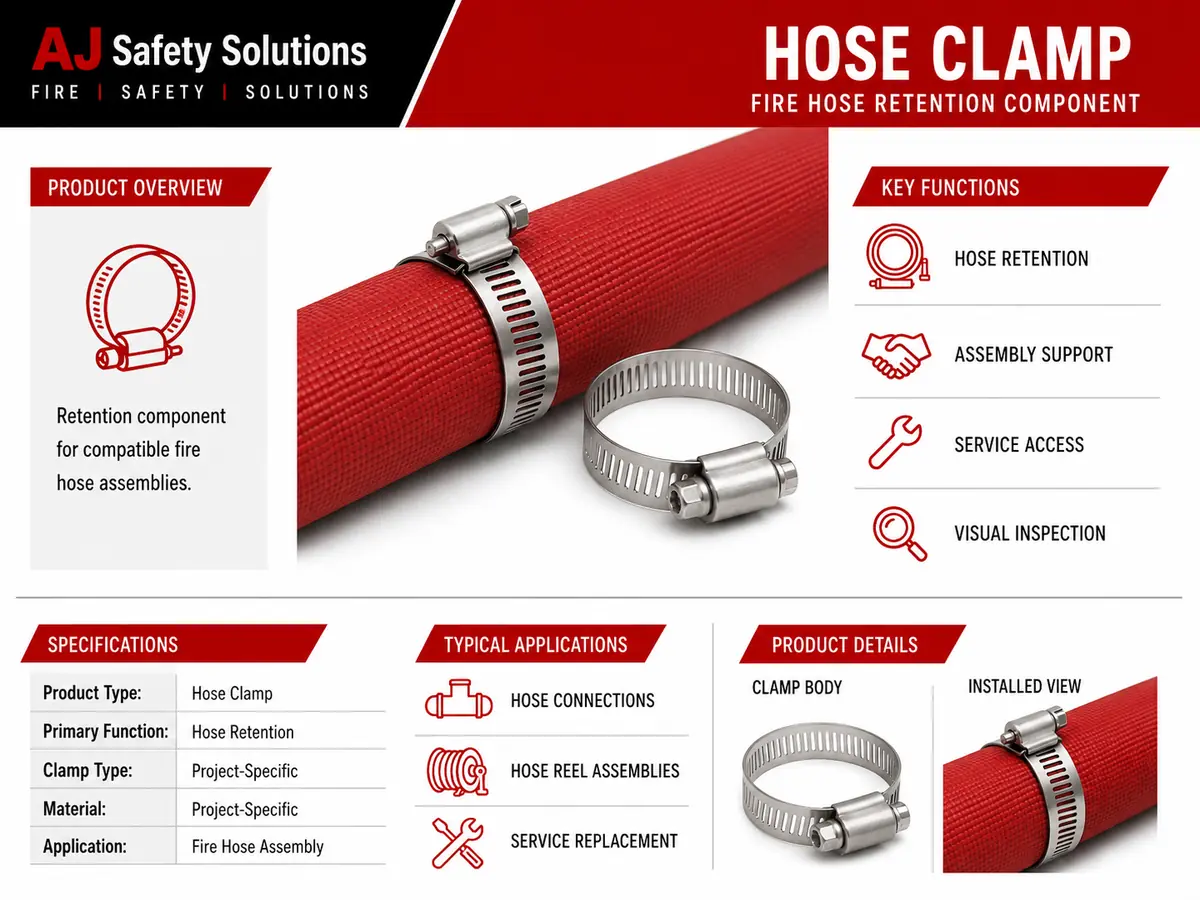
Hose Clamp for Project-Specific Fire Hose Retention
A Hose Clamp provides circumferential retention at a compatible fire hose connection or assembly point. It must suit the hose outside profile, the underlying fitting and the approved attachment method. Because clamp designs vary, the product type, tightening mechanism, material and required installation force must be verified before use.
Coordinate the component with AJ Safety Solutions, review the matching fire hose range, and identify compatible connection parts in the hose reel accessories category.
Retention at the Hose Assembly
The clamp applies retention around the hose where it meets a compatible tail, fitting or other approved support. Correct placement helps keep the connection assembled without cutting, crushing or distorting the hose wall. Installation should use the method, tools and tightening guidance specified for the actual clamp and hose combination.
Functional Considerations
- Provides hose retention at a defined assembly location.
- Project-specific clamp form supports matching with the selected fitting.
- Accessible tightening area allows installation and planned service checks.
- Visible band or body supports inspection for movement and physical condition.
Typical Applications
Hose clamps may be used on compatible hose end assemblies, hose reel connections, maintenance replacements and related fire water components when included in the approved product arrangement. A clamp should not be treated as universally interchangeable; the hose, fitting and retention system must be evaluated together.
Specification and Ordering Notes
Confirm clamp type, adjustment range, band width, material, grade, fastener design, edge form, installation torque or method, environmental suitability, approval, marking and quantity required for each connection. No dimension, torque, corrosion rating, material grade, certification or universal hose compatibility is claimed here.
Inspection and Standards Context
Check the clamp for correct position, looseness, deformation, corrosion, damaged fasteners and any sign of hose cutting, crushing or leakage. System teams may consult NFPA 14 for relevant standpipe and hose system requirements and NFPA 25 for inspection, testing and maintenance guidance. Manufacturer instructions, approved design details, adopted codes and the authority having jurisdiction remain controlling.






Reviews
There are no reviews yet.