
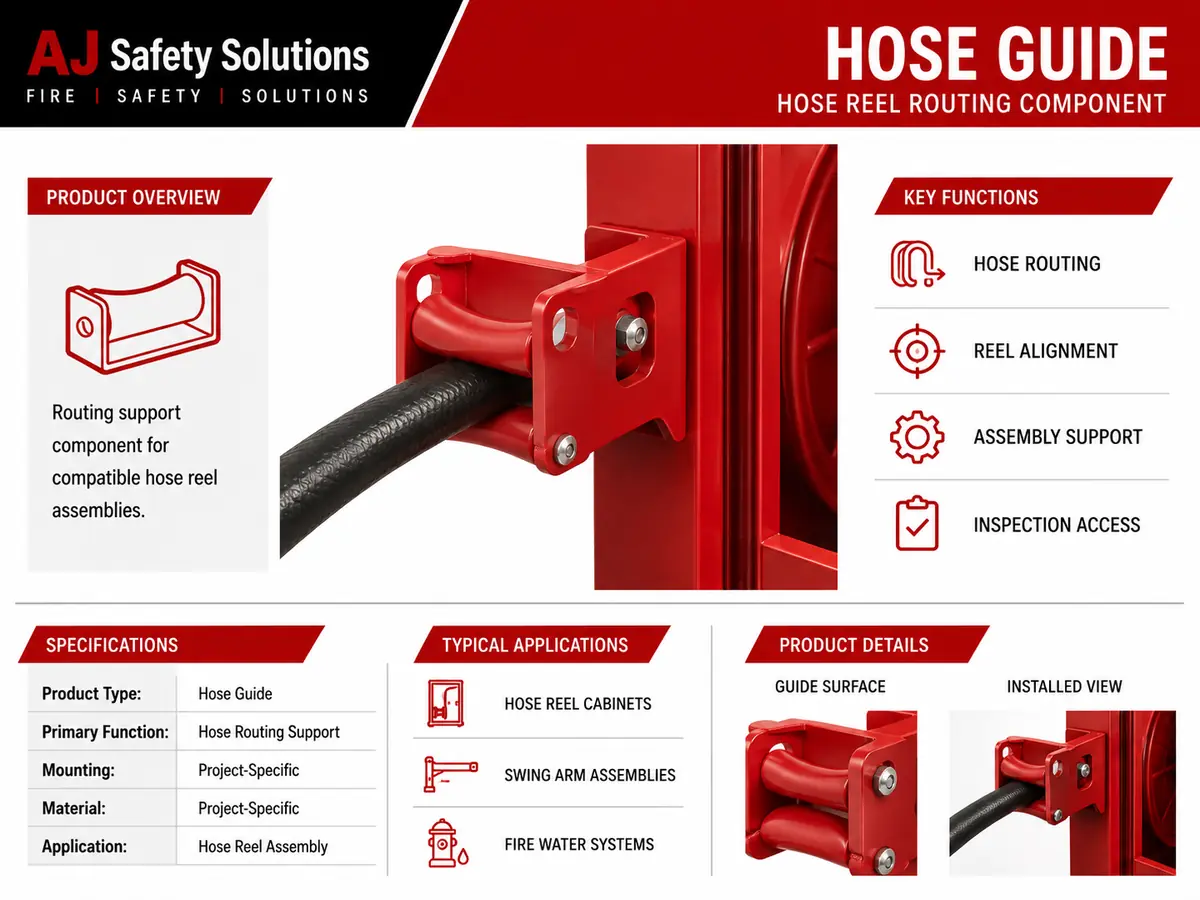
Hose Guide for Fire Hose Reel Routing Support
A Hose Guide provides a defined routing point for hose leaving or returning to a compatible reel, cabinet or swing-arm assembly. The guide helps align the hose path with the equipment opening and intended deployment direction. Its effectiveness depends on correct position, smooth contact surfaces and compatibility with the actual hose profile and reel geometry.
Plan the routing component with AJ Safety Solutions, review the connected fire hose products, and coordinate the guide with approved hose reel equipment.
Controlled Hose Path
The hose passes across or through the guide as it is deployed and rewound. Depending on the selected design, guiding surfaces may be fixed, curved or rolling, but no particular mechanism is assumed in this generic record. The installed position should avoid sharp edges, pinch points, excessive friction and misalignment with the reel drum.
Functional Considerations
- Supports a defined route between the hose reel and deployment direction.
- Helps coordinate hose alignment with the cabinet or equipment opening.
- Accessible guide surfaces allow cleaning and routine visual inspection.
- Project-specific mounting enables integration with the approved reel assembly.
Typical Applications
Hose guides may be coordinated with fixed hose reels, swing-arm assemblies, recessed or surface-mounted cabinets and other approved fire water delivery equipment. Installation must preserve access to the hose, avoid obstructing reel movement and allow the hose to deploy along the route established by the project design.
Specification and Ordering Notes
Confirm guide form, hose clearance, mounting position, fastener arrangement, material, finish, contact surface, roller configuration if applicable, cabinet compatibility, environmental suitability, approval and included hardware. No dimension, material grade, mounting spacing, certification or supplied fastener is asserted in this description.
Inspection and Standards Context
Inspect the guide for secure mounting, alignment, rough or damaged contact surfaces, corrosion, seized movement where applicable and any wear transferred to the hose. Refer to NFPA 14 for relevant standpipe and hose system requirements and NFPA 25 for inspection, testing and maintenance guidance. Approved drawings, manufacturer instructions, adopted codes and the authority having jurisdiction determine the final arrangement.










Reviews
There are no reviews yet.