
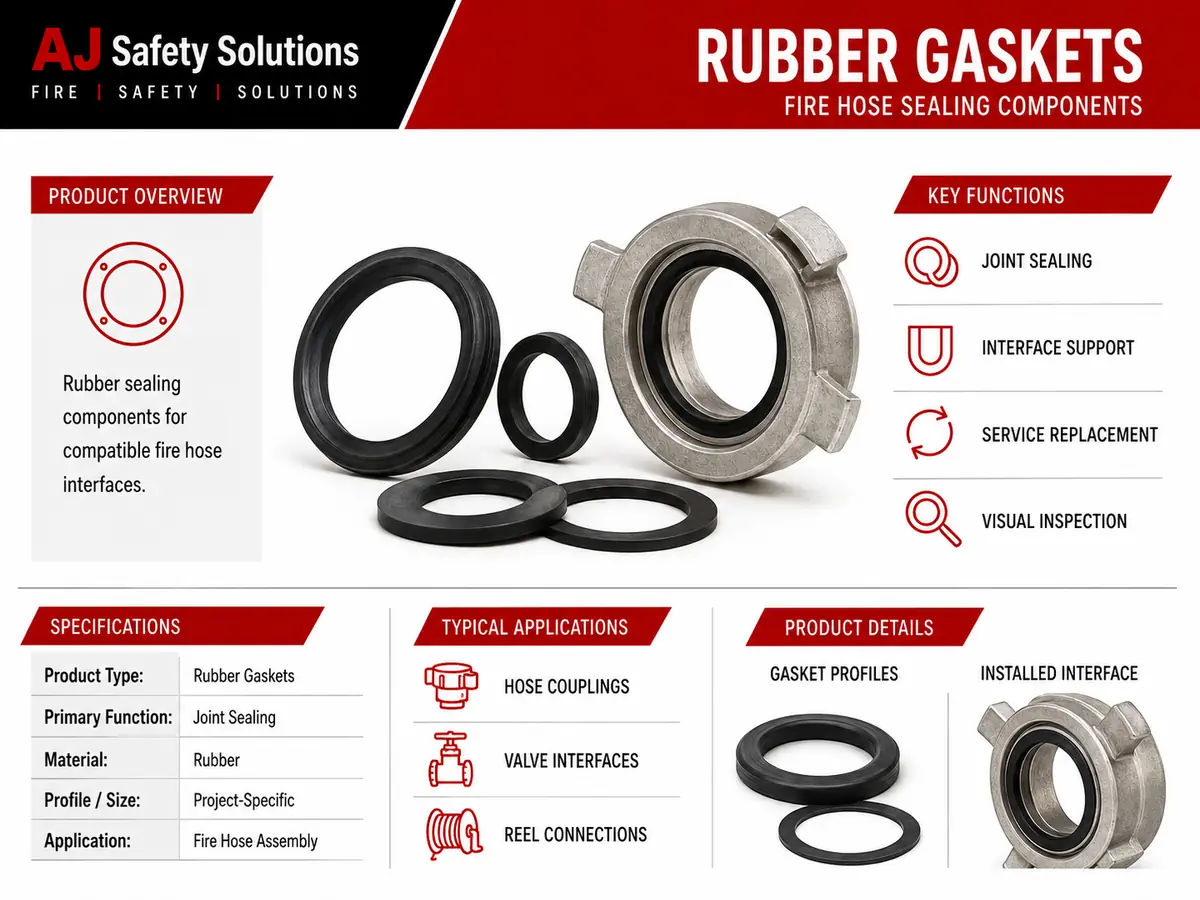
Rubber Gaskets for Compatible Fire Hose Connections
Rubber Gaskets provide compressible sealing elements at compatible fire hose, coupling, valve or reel connection interfaces. When matched to the joint, a gasket occupies the intended sealing space between mating surfaces. Rubber identifies the material family, but the compound, profile, dimensions and pressure or temperature capability must be confirmed for the actual connection.
Coordinate the accessory through AJ Safety Solutions, review the complete hose reel accessories category, and compare the related hose reel testing and maintenance information before finalising the assembly.
Joint Sealing Interface
The gasket is seated in the designated groove, face or coupling recess so that assembly compression forms the intended seal. Correct profile and placement are important because an undersized, oversized, twisted or incompatible gasket may not sit correctly. Contact surfaces should be clean and undamaged before approved installation.
Key Product Considerations
- Rubber material provides the compressible sealing element named in this record.
- Project-specific profile supports matching with the intended joint geometry.
- Removable gasket form allows inspection and approved service replacement.
- Visible sealing faces provide clear points for condition and seating checks.
Typical Applications
Rubber gaskets may be coordinated with hose couplings, valve interfaces, reel inlet connections, nozzles and other approved fire water joints. Each use requires compatibility with the mating components, expected medium, service environment and manufacturer instructions for the complete assembly.
Specification and Ordering Notes
Confirm gasket profile, inside and outside dimensions, cross-section, rubber type and grade, hardness, colour, pressure and temperature limits, water compatibility, ageing requirements, approval and supplied quantity. No dimension, compound grade, pressure rating, temperature range, certification or package quantity is claimed.
Inspection and Standards Context
Inspect for cuts, cracks, hardening, swelling, flattening, twisting, surface damage, contamination and leakage at the joint. Replace gaskets only with the verified profile and material specified for the connection. Project teams may consult NFPA 14 for relevant standpipe and hose system requirements and NFPA 25 for inspection, testing and maintenance guidance. Adopted codes, approved drawings, manufacturer instructions and the authority having jurisdiction remain controlling.







Reviews
There are no reviews yet.